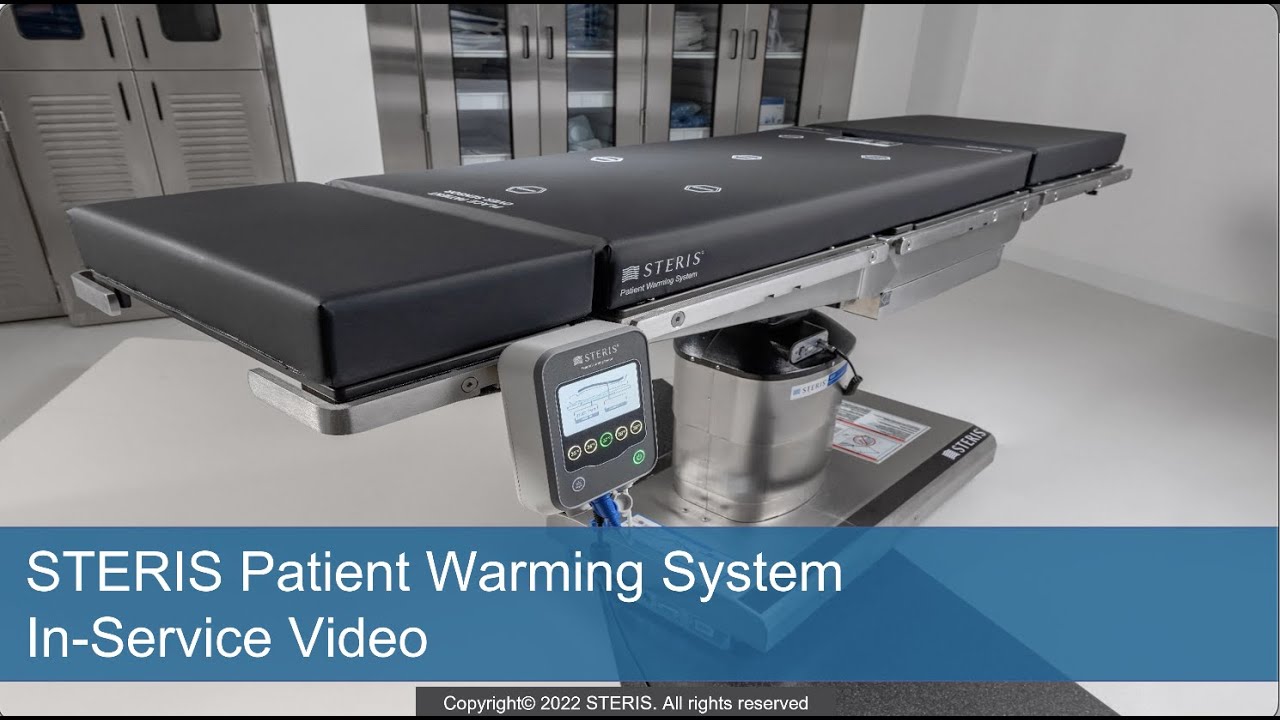
STERIS® Patient Warming System
- Supports efforts to reduce perioperative hypothermia Durable, reusable heating system integrated into the surgical table mattress pads
- Uses conductive, not convective, heat transfer through direct contact with the patient
- Compact design, seamless OR footprint, quiet operation & no blowing air
- Provides heat to the patient before, during or after procedures in the operating room
The STERIS Patient Warming System (PWS) uses a heated surgical table pad and optional overbody blanket immediately upon transfer to the surgical table to provide heat to the patient before, during or after procedures in the Operating Room.
How the STERIS Patient Warming System Works
- Patient Temperature Management – The heated surgical table pad means the patient is warmed from the minute of transfer to the surgical table.
- Conductive, Not Convective – Conductive heat transfer is through direct contact between the patient and the surgical table pad and the overbody blanket.
- Compact Design – A small controller can be mounted to the table side rail or IV pole close to anesthesia. Cables are thin and easy to connect. The durable overbody blanket minimizes bulk that may be a nuisance during use.
Why the STERIS Patient Warming System?
The STERIS Patient Warming System is an Air-Free heating system that uses conductive heat transfer; heat is transferred through direct contact with the surgical table pad or the warming blanket. Studies have shown that forced-air warming generates convection current activity in the vicinity of the surgical site, which may disrupt ventilation airflows intended to clear airborne contaminants from the surgical site. 4
Perioperative hypothermia prevention is about minimizing or eliminating the decline in core temperature before, during and immediately after the induction of anesthesia.1 Patients having shorter surgeries are more likely to experience postoperative hypothermia because there is simply not enough time to overcome the effect of redistribution with intraoperative warming alone.2 The active warming device should be started as soon as possible when the patient arrives and prior to induction of anesthesia.3
1 AORN Guidelines
2 Prevention and Management of Perioperative Hypothermia
3 AORN Guidelines
4 Effect of forced-air warming on the performance of operating theatre laminar flow ventilation
Other surgical table pads - Pressure Reduction System